 Romford Dogs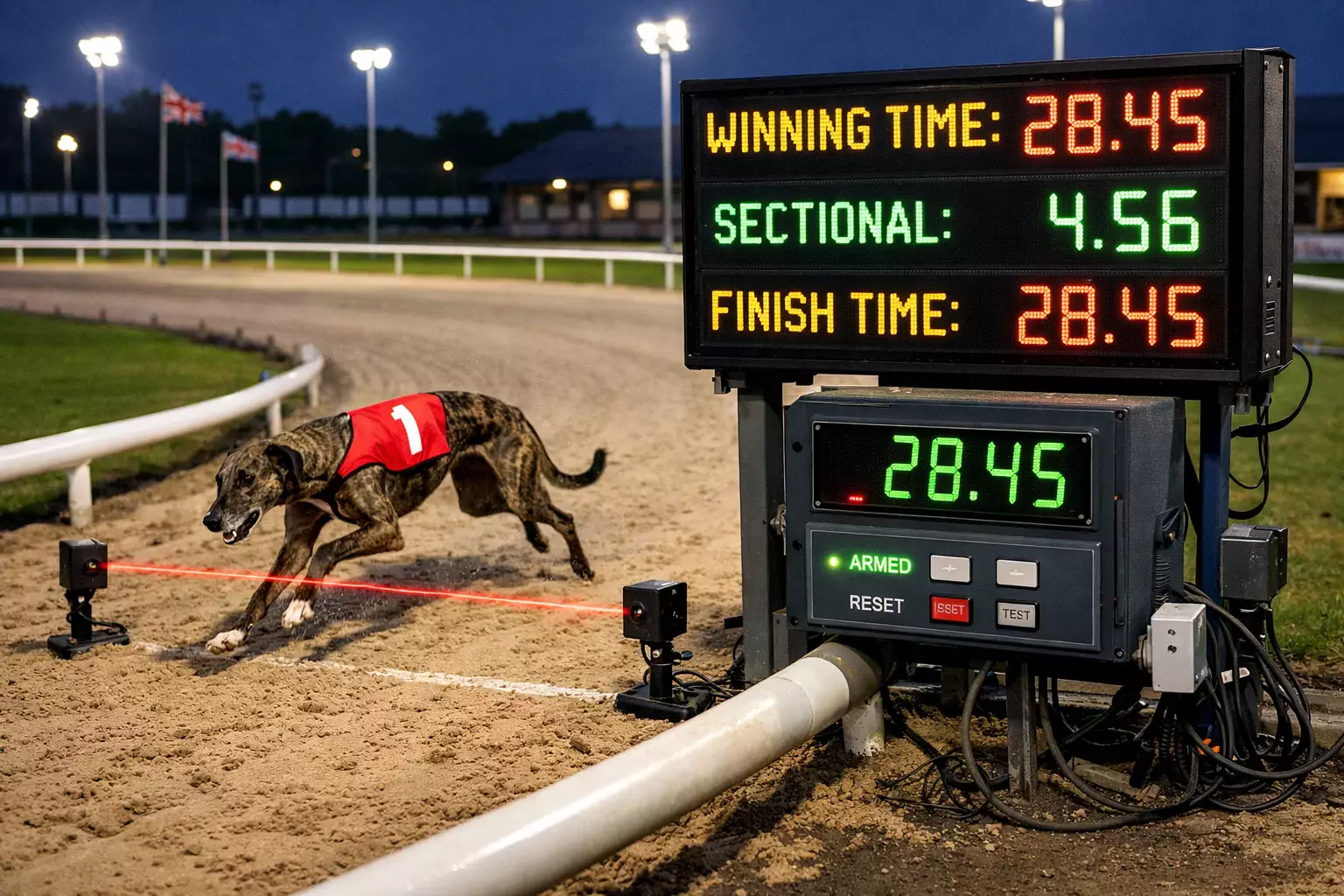
Best Greyhound Betting Sites – Bet on Greyhounds in 2026
Loading...
Finishing time tells you who won and how fast. Sectional times tell you how they won. This distinction matters enormously when assessing greyhound form. A dog that crosses the line in 24.50 seconds might have led from trap to wire, or it might have come from behind with a devastating late burst. The clock treats both scenarios identically, but the racing profiles could not be more different.
Sectional analysis breaks a race into segments, revealing which portion each dog covered quickly and where they gained or lost ground. Speed tells the outcome, but sectionals reveal the method. For punters trying to predict how future races will unfold, understanding these splits provides insight that raw finishing times simply cannot match.
Understanding Sectionals
Most UK tracks time greyhounds at multiple points during a race. The specific timing points vary by track and distance, but the common approach involves measuring time to the first bend, through the middle section, and over the final run-in. Each segment captures a different phase of racing: the break from traps, the bend negotiation, and the finishing effort.
The first sectional, often called the early pace or trap-to-bend time, measures how quickly a dog clears the first portion of the race. Fast early pace suggests a runner that breaks sharply, shows early speed, and ideally leads or sits prominently through the opening exchanges. Slow early pace indicates either a poor trap exit or a dog that naturally runs from behind.
Calculated vs Actual Time
A crucial distinction exists between calculated and actual sectional times. Actual sectionals come from timing equipment installed at specific points around the track. Not every venue has comprehensive timing infrastructure, so some sectional data is calculated by subtracting one known time from another.
Calculated times carry inherent imprecision. If a track times at the first bend and the finish but nowhere else, any mid-race sectionals must be estimated rather than measured. This matters when comparing data across venues or when small differences might influence betting decisions. Treat calculated sectionals as indicative rather than definitive.
What the Numbers Mean
Interpreting sectional data requires context. A first-bend time of 5.20 seconds means nothing in isolation. Is that fast for this track? Does the trap position affect the measurement? Did the dog show that pace despite interference or thanks to a clear run?
Comparison provides meaning. Look at the sectional against the field: was this dog clearly fastest to the bend, or did several runners clock similar times? Compare against the same dog’s previous runs: has the early pace improved, declined, or stayed consistent? Compare against the track standard: what do good dogs typically record for this split?
Over time, patterns emerge. Some dogs consistently show fast early sectionals but fade in the run-in. Others break modestly but finish powerfully. Identifying these profiles helps predict how dogs will interact when they meet. Two quick breakers drawn in adjacent traps may compromise each other. A strong finisher drawn behind moderate early pace may find the room to close.
Sectional Data Sources
Official timing data comes from track-installed equipment. Services like Timeform compile and publish sectional information alongside standard form data. Some providers calculate additional metrics from the raw sectionals, attempting to isolate a dog’s true ability from the circumstances of each race.
Quality varies between sources. Premium data services tend to offer more granular sectional breakdowns, while free resources may provide only basic first-bend times. For serious form study, access to detailed sectionals repays the investment.
Early Pace vs Finishing Speed
Greyhound racing rewards early pace more heavily than most other racing disciplines. Unlike horse racing where closing speed wins many contests, greyhound races often end before slow starters can recover. The short distances, tight tracks, and minimal time for manoeuvring all favour dogs that establish position early and defend it.
This structural advantage makes early sectional times particularly valuable. A dog that consistently reaches the first bend in front has removed much of the uncertainty from its races. Clear early leaders rarely face the crowding, interference, and lost momentum that plague mid-pack runners. They set the pace, hold the rail, and force rivals to go around them.
When Finishing Speed Matters
Strong closing ability remains relevant in specific circumstances. Longer distances give finishers more time to recover ground. Tracks with long run-ins from the final bend amplify late pace. Races where multiple fast breakers compete often see the early speed merchants compromise each other, opening gaps for closers to exploit.
The ideal profile combines both assets: sharp enough early to secure position, strong enough late to hold off challenges. Finding dogs that tick both boxes takes work. Sectional data helps identify them by showing whether a quick overall time came from blazing early and fading, steady throughout, or moderate early and storming home.
Race Shape Predictions
Combining sectional profiles across a six-dog field reveals the likely race shape. If three runners show strong early pace and drew inside traps, expect a contested lead and potential interference. If only one dog shows genuine early speed, that runner may enjoy an uncontested front-running trip.
These predictions inform trap draw analysis. A fast-breaking dog from trap one holds natural advantages: shortest path to the first bend, rail position throughout. The same dog from trap six faces a longer journey to reach the bend, more rivals to navigate past, and greater risk of crowding.
Sectionals also help identify improving or regressing dogs. A runner whose finishing sectionals have quickened over recent starts may be reaching peak fitness or finding a running style that suits. Conversely, a dog whose early pace has slowed might be losing its crucial first-step sharpness, a warning sign regardless of overall finishing times.
Using Sectionals at Romford
Romford’s 350-metre circumference creates specific sectional benchmarks. The track’s dimensions affect how much distance dogs cover to reach timing points, making direct comparison with larger or smaller venues misleading. What constitutes a fast first-bend time at Romford differs from the equivalent at Nottingham or Towcester. With over 355,000 races run annually across UK licensed tracks, sectional data provides a vast pool for comparative analysis.
The standard 400-metre distance at Romford serves as the baseline for most sectional analysis. This trip includes two bends, with timing typically recorded to the first bend and at the finish. The split reveals how a dog handles the early running and whether it maintains pace through the second half of the race.
Distance-Specific Considerations
Shorter distances like Romford’s 225-metre sprint place almost all emphasis on early pace. Over such brief trips, dogs have minimal opportunity to recover from slow starts. Sectionals from sprint races tend to correlate tightly with finishing positions: fastest to the bend usually means first across the line.
Longer trips tell more complex stories. The 575-metre and 750-metre distances at Romford involve additional bends and extended run-ins. Sectional analysis over these distances requires attention to where a dog’s strengths lie. A runner that shows only moderate early pace but exceptional finishing sectionals may struggle over sprints yet thrive at marathon distances.
The 925-metre extreme distance at Romford tests stamina profoundly. Sectional analysis here focuses less on trap-to-bend speed and more on pace distribution. Dogs that maintain consistent sectionals throughout these long races outperform those who blaze early and capitulate.
Practical Application
Building a personal database of Romford sectionals improves analysis over time. Note the first-bend times of each runner, track which traps tend to produce quick early sectionals, and observe how different going conditions affect the numbers. Across the 18 licensed UK tracks operating as of January 2025, each venue presents unique sectional benchmarks shaped by circumference, surface composition, and bend configurations. This accumulated knowledge converts raw data into genuine insight.
Pay particular attention to sectional patterns on specific race days. Wet weather, fresh sand, or track maintenance can shift the benchmarks temporarily. A fast early sectional on a slow evening might represent outstanding effort; the same split on a quick surface might be merely average.
Important Information
Sectional times provide analytical tools but cannot predict race outcomes with certainty. Multiple factors beyond timing data influence greyhound performance. Betting on greyhound racing involves financial risk, and you should only stake money you are prepared to lose. Support organisations including GamCare and BeGambleAware offer help if gambling causes problems.
This guide is for educational purposes and does not constitute betting advice. No relationship exists between this content and the GBGB, Romford Stadium, or any betting operator.