 Romford Dogs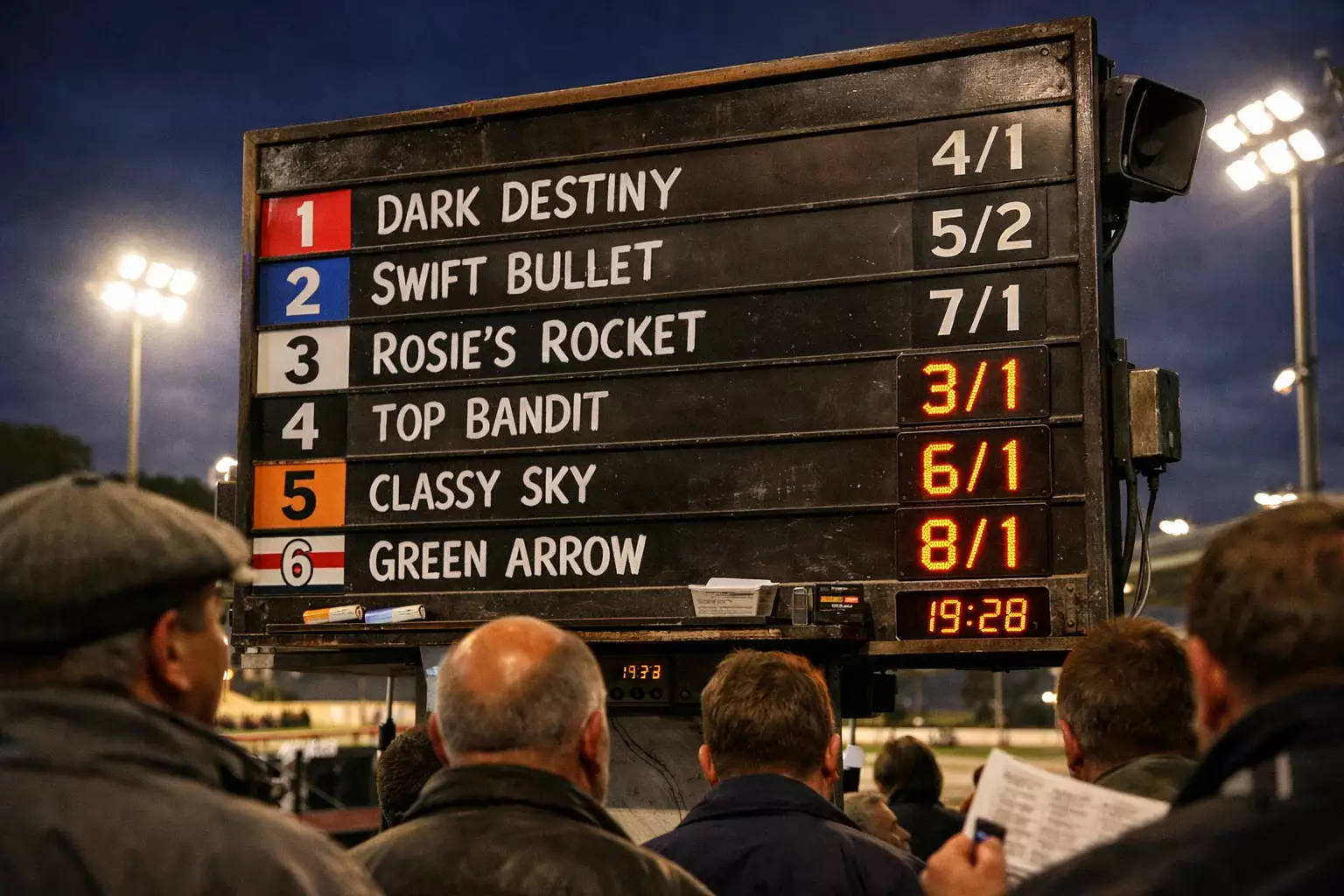
Best Greyhound Betting Sites – Bet on Greyhounds in 2026
Loading...
Numbers that pay. That is what betting odds represent, stripped to their essence. Whether displayed as fractions, decimals, or tote dividends, odds tell you two things: how likely the bookmaker thinks an outcome is, and how much you stand to win if that outcome occurs. Understanding the different formats and how they relate to each other removes a barrier that keeps casual punters from making informed decisions.
UK greyhound betting uses multiple odds formats depending on where and how you bet. Traditional bookmakers at the track and in high street shops typically display fractional odds. Online operators often default to decimal odds, though most allow you to switch formats. The tote operates differently altogether, with dividends determined by pool size rather than set in advance. Each format has its logic, and once you grasp the underlying principles, converting between them becomes straightforward.
The scale of UK greyhound betting makes this knowledge relevant. According to industry data, approximately £1.81 billion was wagered on UK greyhound racing in 2024. That money flows through various channels using different odds presentations. Knowing what those numbers mean puts you in a better position to allocate your stake.
Fractional vs Decimal
Fractional odds express your potential profit relative to your stake. Odds of 5/1 (five to one) mean you win £5 for every £1 staked, plus your original stake back. Odds of 1/2 (one to two, or odds-on) mean you win £1 for every £2 staked. The first number represents potential profit; the second represents the stake required to generate that profit.
Decimal odds include your stake in the figure. The same 5/1 fractional odds become 6.00 in decimal format. To calculate your total return, multiply your stake by the decimal odds. A £10 bet at 6.00 returns £60 total, which includes your £10 stake plus £50 profit. The 1/2 fractional odds become 1.50 in decimal. A £10 bet at 1.50 returns £15 total.
Converting Between Formats
Converting fractional to decimal requires simple arithmetic. Divide the first number by the second, then add 1. For 5/1: divide 5 by 1 to get 5, add 1, giving 6.00. For 9/4: divide 9 by 4 to get 2.25, add 1, giving 3.25. For 11/10: divide 11 by 10 to get 1.1, add 1, giving 2.10.
Converting decimal to fractional reverses the process. Subtract 1 from the decimal, then express as a fraction. From 4.00: subtract 1 to get 3, express as 3/1. From 2.50: subtract 1 to get 1.5, express as 3/2. Some conversions produce awkward fractions; bookmakers typically round to standard increments like 5/2, 11/4, or 9/2.
Implied Probability
Both formats encode probability, though neither displays it directly. Decimal odds convert to implied probability by dividing 1 by the odds, then multiplying by 100. Odds of 4.00 imply a 25% chance (1 ÷ 4 × 100). Odds of 2.00 imply a 50% chance. Odds of 1.50 imply approximately 67%.
Understanding implied probability helps assess value. If you believe a dog has a 30% chance of winning but the odds imply only 20% probability, the bet offers value. If the odds imply 40% probability for a dog you rate at 30%, the bookmaker expects more than you believe the dog deserves. Value betting means consistently finding situations where your assessment exceeds the market’s implied probability.
Why Formats Differ
Tradition explains much of the format divergence. UK bookmaking developed with fractional odds, and established customers remain comfortable with them. Decimal odds gained popularity through betting exchanges and international markets where fractions would require awkward notation. Neither format is superior; they express identical information differently.
Tote Dividends
Tote betting operates fundamentally differently from fixed-odds betting. Rather than accepting odds at the moment you place your bet, you join a pool of bettors. After the race, the total pool is divided among winning tickets, minus the operator’s deduction. The dividend you receive depends on how much money backed the winner relative to the entire pool.
This means you cannot know your precise return when placing a tote bet. Odds displays showing approximate tote prices update throughout the betting period but remain estimates until the pool closes. A late surge of money on your selection reduces your dividend; a late drift increases it. You are betting against other punters as much as against the bookmaker.
Dividend Calculation
The basic calculation divides the pool by the amount staked on the winner, producing a return per unit. If a win pool contains £10,000 after deductions and £2,000 backed the winner, each £1 winning ticket receives £5. Tote dividends are typically declared to a £1 unit, showing what a £1 winning bet returns.
Deductions vary by pool type and operator. The percentage taken before dividends are calculated funds the tote’s operation and contributes to prize money and industry levies. These deductions explain why tote returns sometimes appear less generous than bookmaker odds, though pools with lightly-backed winners can produce dividends exceeding bookmaker prices.
Pool Types and Returns
Different tote pools suit different betting styles. Win pools pay on the winner only. Place pools pay on finishers that meet the place terms, typically the first two or three. Forecast pools require predicting first and second in order; tricast pools require first, second, and third.
The British Greyhound Racing Fund collects £6.75 million annually from bookmaker contributions, with tote operations forming part of the broader betting ecosystem that supports licensed greyhound racing. Pool betting contributes to this funding structure while offering bettors an alternative to fixed-odds betting.
Calculating Returns
Return calculation follows directly from understanding the odds format. For fixed odds, the calculation happens once and remains fixed. For tote bets, you can only calculate returns after the dividend is declared. Either way, the arithmetic is straightforward once you know the relevant numbers.
Fixed Odds Returns
With fractional odds, multiply your stake by the fraction, then add your stake. A £10 bet at 7/2 yields £35 profit (10 × 3.5), plus your £10 stake, giving £45 total return. With decimal odds, multiply stake by odds. A £10 bet at 4.50 returns £45 total. Same result, different route.
Each-way bets require two calculations. The win part uses the full odds. The place part uses reduced odds, typically a fraction of the win odds determined by the number of runners. A £10 each-way bet (£20 total) at 10/1 with 1/4 place terms returns £110 profit on the win part (£10 × 10) plus £25 profit on the place part (£10 × 2.5, being 10/1 at quarter odds), plus your £20 stake back. If the dog places but does not win, you receive only the place return.
Tote Returns
Tote calculations use the declared dividend. If the win dividend shows £8.40 to £1 and you staked £5, your return is £42 (5 × 8.40). Forecast and tricast dividends work identically; multiply your stake by the declared dividend per unit.
Overround and Value
Bookmaker odds include a margin called the overround. If you convert all odds in a market to implied probabilities and add them, the total exceeds 100%. This excess represents the bookmaker’s theoretical profit. A market summing to 115% has a 15% overround. The tote equivalent is the deduction percentage.
Identifying value means finding selections where your assessed probability exceeds the implied probability after accounting for the overround. This requires both accurate assessment of race chances and attention to how odds move. Markets are not always right, but they are not easily wrong either.
Important Notice
This article explains greyhound betting odds formats for educational purposes and does not constitute betting advice or encourage gambling. All betting involves risk of financial loss. Odds and dividends described are examples; actual betting outcomes vary. Never bet more than you can afford to lose. If you choose to bet, use responsible gambling tools including deposit limits and self-exclusion options. Problem gambling support is available from GambleAware and the National Gambling Helpline. You must be 18 or over to bet in the UK.