 Romford Dogs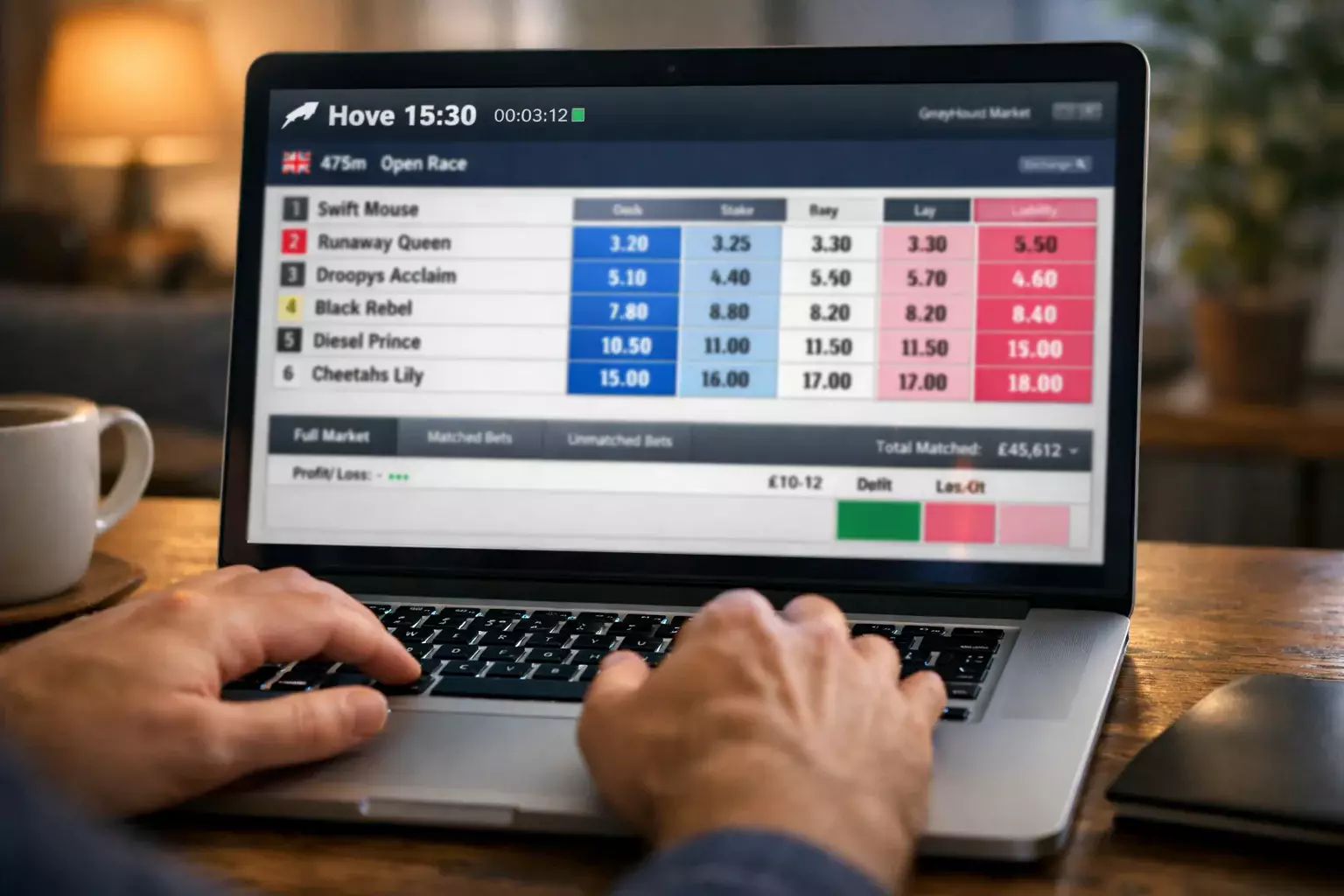
Best Greyhound Betting Sites – Bet on Greyhounds in 2026
Loading...
Two prices exist for every greyhound at race time: the traditional starting price offered by bookmakers and the Betfair starting price generated on the betting exchange. These figures often differ, sometimes significantly. Understanding why they diverge and when each offers better value separates sophisticated punters from those who accept whatever price appears first. Price matters, and knowing which price to take can determine long-term profitability.
The distinction reflects fundamentally different market structures. Bookmaker prices emerge from traders managing risk and building margin. Exchange prices emerge from punters betting against each other with the platform taking a commission. Each mechanism produces its own odds, and smart bettors learn to compare before committing money.
SP vs BSP Explained
The starting price, commonly abbreviated SP, represents the final odds offered by traditional bookmakers at the moment the race begins. Industry reporters collate prices from multiple betting shops and on-course bookmakers to determine the official SP. This figure settles bets placed at SP and provides the benchmark against which early prices are compared.
SP reflects bookmaker assessment of each runner’s chances, adjusted for the money they have taken on each dog. If one runner attracts heavy support, its SP shortens while others drift. The resulting prices incorporate both probability estimates and market forces, though bookmaker margin ensures the combined implied probabilities exceed 100 percent.
Betfair Starting Price
The Betfair SP, or BSP, emerges from exchange activity rather than bookmaker trading. As punters back and lay runners on the exchange, a market price forms. At race time, the final matched price becomes the BSP. This figure applies to unmatched bets that requested BSP and provides an alternative settlement basis.
BSP tends to offer tighter margins than bookmaker SP because the exchange operates differently. Betfair takes commission on winning bets rather than building margin into prices. This structural difference often produces better odds for punters, particularly on less popular selections where bookmaker margins widen.
Why Prices Differ
Several factors drive divergence between SP and BSP. Different customer bases influence each market: traditional punters favour bookmakers while sophisticated bettors often prefer exchanges. Money flows differ, with sharp money sometimes hitting exchanges before filtering to bookmakers. Timing matters too, as exchange prices can shift rapidly in final moments while SP reflects earlier positions.
UK greyhound betting turnover has declined 15 percent since 2020, and the composition of that turnover has shifted alongside. Exchange betting has grown relative to traditional bookmaking, altering the relationship between SP and BSP. More liquidity on exchanges means tighter spreads and prices that often beat bookmaker offerings.
Practical Implications
Taking SP guarantees a price but surrenders control over what that price will be. Taking BSP similarly defers final odds until race time but accesses exchange-derived prices. Taking a fixed price before the off locks in known terms but risks missing better odds that emerge later.
Each approach suits different situations. SP makes sense when confident a selection will shorten and current prices seem generous. BSP suits selections expected to drift or when exchange prices historically outperform bookmaker SP. Fixed prices suit those who value certainty over optimisation.
Exchange Betting Basics
Betting exchanges operate as platforms where punters bet against each other rather than against a bookmaker. Every bet requires two sides: someone backing a selection to win and someone laying it to lose. The exchange matches these opposing views, takes commission from the winner, and processes settlement automatically.
This peer-to-peer model eliminates traditional bookmaker margin from prices. Instead of prices skewed to guarantee bookmaker profit, exchange prices reflect genuine market opinion. Commission rates, typically between two and five percent depending on turnover, represent the exchange’s revenue rather than embedded margin.
Backing and Laying
Backing on an exchange works identically to backing with a bookmaker: stake money on a selection to win, collect if correct. Laying represents the opposite position: accepting someone elses back bet by agreeing to pay out if the selection wins. Layers collect the backers stake if the selection loses.
Laying carries different risk profiles than backing. A layers liability equals potential winnings the backer would receive. Laying a 5/1 shot means risking five times the backers stake to win that stake. Understanding this asymmetry matters for anyone using exchanges beyond simple backing.
Commission Structure
Exchange commission applies only to net winnings. Lose a bet and no commission is charged. Win a bet and commission reduces the return. High-volume customers qualify for reduced commission rates through loyalty programmes, making exchanges increasingly attractive as betting activity grows.
The commission model favours long-term punters over casual players. Someone placing occasional bets pays the same rate regardless of outcome. Someone betting regularly and profitably sees commission accumulate but also benefits from typically better prices that may compensate.
The British Greyhound Racing Fund receives contributions from bookmakers at 0.6 percent of greyhound betting turnover. Exchange operators contribute differently, with arrangements that reflect their distinct business model.
Finding Value
Value exists when available odds exceed a selections true winning probability. Finding value requires either accurate probability assessment or systematic exploitation of market inefficiencies. Comparing SP and BSP provides one route to identifying such opportunities.
Track historical differences between SP and BSP for greyhound racing. Some race types consistently show BSP exceeding SP, offering better returns for those who choose exchange settlement. Other scenarios favour traditional bookmaker prices. Building personal records of these patterns informs future decisions.
Market Timing
Odds move throughout the betting period. Early prices may offer value that evaporates as money arrives. Late movements may correct earlier mispricing or introduce new biases. Understanding when to bet and which price mechanism to use maximises returns from accurate selections.
Exchange markets often show more dramatic late movement than bookmaker prices. Sharp money arriving close to race time can shift BSP significantly from prices available minutes earlier. Those who can monitor markets in real-time gain advantages over those who bet and walk away.
Practical Approach
Maintain accounts with both traditional bookmakers and betting exchanges. Compare prices before every bet rather than defaulting to a single platform. When odds look similar, consider which settlement basis benefits most: fixed early price, SP, or BSP.
Record keeping transforms casual observation into systematic knowledge. Note which bet types and race types produce the largest SP/BSP divergences. Over hundreds of bets, patterns emerge that would never surface from memory alone.
Accept that no single approach suits every situation. Sometimes bookmaker SP proves best. Sometimes BSP wins. Sometimes taking an early price beats both. Flexibility and comparison produce better long-term results than rigid adherence to any single method.
Romford Considerations
Exchange liquidity varies by track and meeting type. Major evening meetings at Romford attract more exchange activity than weekday BAGS sessions, contributing to the approximately £1.81 billion in UK greyhound wagering turnover recorded in 2024. Where liquidity thins, BSP may reflect fewer matched bets and potentially less accurate prices. Factor this variation into decisions about which price mechanism to use for specific meetings.
Important Information
Betting odds fluctuate and past price patterns do not guarantee future outcomes. Betting on greyhound racing involves financial risk, and stakes should reflect amounts you can afford to lose. Support services including GamCare and BeGambleAware provide assistance if gambling becomes problematic.
This guide is provided for educational purposes only and does not constitute betting advice. No affiliation exists between this publication and any bookmaker, betting exchange, or racing organisation.