 Romford Dogs
  Available in US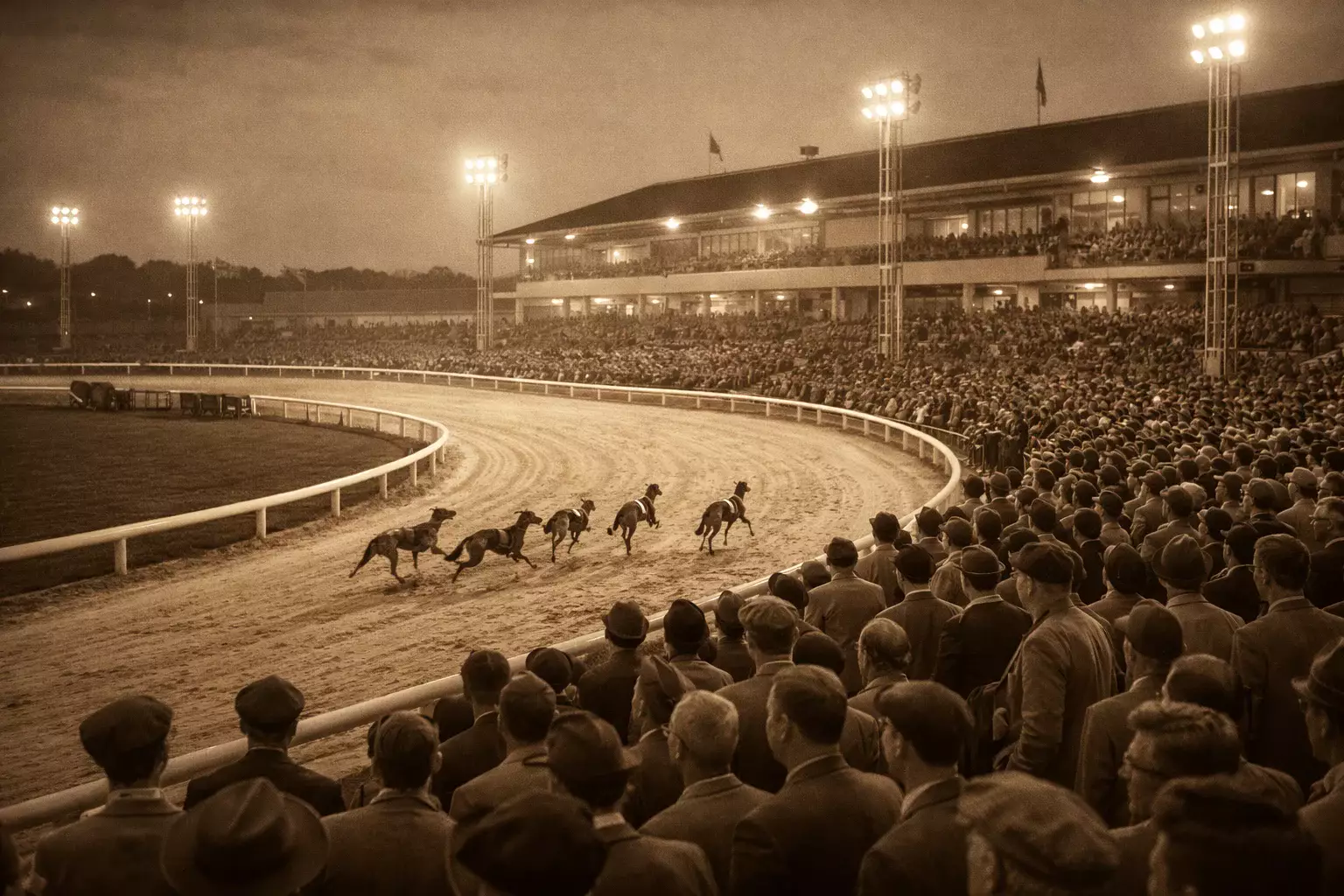
British greyhound racing spans nearly a century of social history, from packed stadiums in industrial cities to the handful of tracks that survive today. The sport arrived from America in 1926, exploded into a national phenomenon within years, and has been declining ever since its post-war peak. Understanding this trajectory helps contextualise modern racing at venues like Romford, the last survivor of what was once a thriving London circuit. A century of racing compressed into a single track.
The story involves more than nostalgia. Economic forces that closed dozens of stadiums continue to pressure surviving venues. Welfare concerns that shadowed the sport since its earliest days now drive regulatory frameworks. The lessons of history inform present challenges and shape what the future might hold for British greyhound racing.
Origins and Golden Era
Greyhound racing arrived in Britain when Belle Vue Stadium in Manchester hosted the first organised meeting on 24 July 1926. The American import found immediate success, with crowds packing the venue to watch dogs chase a mechanical hare around an oval track. Within months, promoters opened stadiums across the country, recognising the appetite for affordable entertainment that combined spectacle with betting opportunity.
White City Stadium in London became the sport’s flagship venue, hosting prestigious competitions that attracted enormous crowds. The stadium’s capacity exceeded 90,000, and major race nights filled it to bursting. Greyhound racing offered working-class audiences entertainment within reach of their budgets, with admission prices and minimum bets set low enough to ensure accessibility.
Expansion Through the 1930s
The sport grew explosively through its first decade. By the late 1930s, greyhound tracks dotted cities and towns throughout Britain. The National Greyhound Racing Club, established in 1928, brought organisation and standardisation to what had been a chaotic proliferation of venues and rules. Licensed tracks operated under consistent regulations while independent “flapping” tracks continued outside the official structure.
Attendances reached remarkable levels. The sport rivalled football for spectator numbers, with annual attendance figures climbing into tens of millions. Betting turnover grew correspondingly, making greyhound racing a significant economic activity as well as popular entertainment.
Post-War Peak
The immediate post-war years marked British greyhound racing’s zenith. In the late 1940s, over 77 licensed tracks operated alongside more than 200 independent venues. Annual attendance exceeded 50 million, figures that seem almost unimaginable compared to modern levels. The sport occupied a central place in British leisure culture, particularly in industrial areas where it provided evening entertainment close to working communities.
This peak proved unsustainable. Television arrived, offering free entertainment at home. Car ownership expanded, enabling access to more distant leisure options. The specific conditions that made greyhound racing thrive began shifting even as the sport celebrated its greatest popularity.
Cultural Significance
Greyhound racing occupied a distinctive social niche. Unlike horse racing with its associations with aristocracy and country estates, the dogs belonged to urban and working-class Britain. Tracks sat in industrial heartlands, accessible by tram and bus to communities that filled their terraces on race nights. The sport’s culture reflected this base: informal, unpretentious, integrated into everyday life rather than set apart as special occasion.
Literature, film, and popular memory preserve fragments of this era. The atmosphere of packed stadiums, the characters who populated trackside bars, the rituals of studying form and placing bets: all formed part of a distinctive subculture that has largely vanished along with the venues that housed it.
Decline and Track Closures
The contraction began gradually in the 1960s and accelerated through subsequent decades. Attendance fell as entertainment options multiplied. Betting shops legalised in 1961 drew some of the gambling-motivated crowd away from trackside. Property values in urban areas made stadium sites increasingly attractive to developers, creating financial pressure to sell rather than continue racing.
White City, the sport’s grand cathedral, closed in 1984. Its site became a shopping centre and residential development. This single closure symbolised broader transformation: greyhound racing’s prime real estate increasingly commanded greater value for alternative uses than the sport could justify maintaining.
Economic Pressures
Stadium economics became progressively more challenging. Maintenance costs for ageing facilities mounted while attendance revenue declined. The betting industry’s structure disadvantaged greyhound racing relative to horse racing, with lower levy contributions and less regulatory protection. Tracks operated on thin margins that closure often seemed the rational choice.
Each closure concentrated racing at fewer venues, potentially strengthening survivors but also raising questions about critical mass. Could the sport maintain relevance with a shrinking footprint? Would remaining tracks attract sufficient interest to justify continued operation?
Regional Impacts
The closures fell unevenly across regions. London lost track after track while maintaining enough population to theoretically support multiple venues. Northern industrial cities saw closures accelerate as deindustrialisation eroded the working-class communities that had provided core audiences. Coastal tracks dependent on tourism struggled as holiday patterns shifted.
The Modern Circuit
Today just 18 licensed tracks remain across the United Kingdom, a stark reduction from the 77 that operated at the sport’s peak. This number dropped further in January 2025 when Crayford Stadium closed, removing London’s second-to-last venue and leaving Romford as the sole survivor in the capital.
The global industry analysis documents this trajectory alongside similar patterns in other countries. British greyhound racing’s decline mirrors broader trends, though local factors including property values and regulatory environment shape the specific pace and pattern of closures.
Romford’s Survival
Romford Stadium opened in 1929, just three years after British greyhound racing began. The venue has operated continuously since, surviving world wars, economic upheavals, and the industry contraction that claimed dozens of competitors. Its persistence reflects both fortunate circumstances and deliberate adaptation to changing conditions.
Location has helped. Romford sits at the eastern edge of London, accessible by public transport yet not commanding the astronomical land values of more central sites. The stadium occupies space without the intense development pressure that pushed out tracks closer to the capital’s core.
Adaptation and Investment
Survival required more than lucky geography. The track modernised facilities, maintained racing standards, and built relationships with the betting industry that provide crucial revenue streams. Six meetings per week across different time slots generate consistent activity, supporting the infrastructure necessary for continued operation.
The closure of Crayford in 2025 concentrated Southeast racing at Romford, potentially strengthening its position. Trainers previously splitting entries between venues now focus on Romford. Punters who followed both tracks now follow one. This consolidation could enhance field quality and betting interest, though it also highlights Romford’s isolation as London’s last track.
Future Prospects
Whether Romford continues for another century or faces eventual closure depends on factors both within and beyond the sport’s control. Property development pressure remains latent. Betting industry economics continue evolving. Welfare regulations may tighten further. Each variable shapes viability in ways that cannot be confidently predicted.
The track represents living history, a direct connection to 1920s origins that few other venues can claim. Whatever happens next, Romford has already secured its place in British greyhound racing’s story as the track that kept London racing alive when others could not.
Lessons from History
A century of greyhound racing offers clear lessons. No leisure activity remains immune to social change. Economic pressures eventually reach even beloved institutions. Survival requires adaptation, not merely persistence. The tracks that closed were not necessarily worse than those that remained; they simply faced circumstances that made continuation impossible.
Important Information
Historical information reflects sources available at time of writing. Track status and industry conditions change over time. This article provides historical context and does not constitute prediction about future developments in greyhound racing.
This content is provided for informational purposes only. No affiliation exists between this publication and any racing venue, governing body, or industry organisation.
UK Greyhound Racing History — More on this topic at results romford dogs.
See also Greyhound Starting Prices vs BSP.
