 Romford Dogs
  Available in US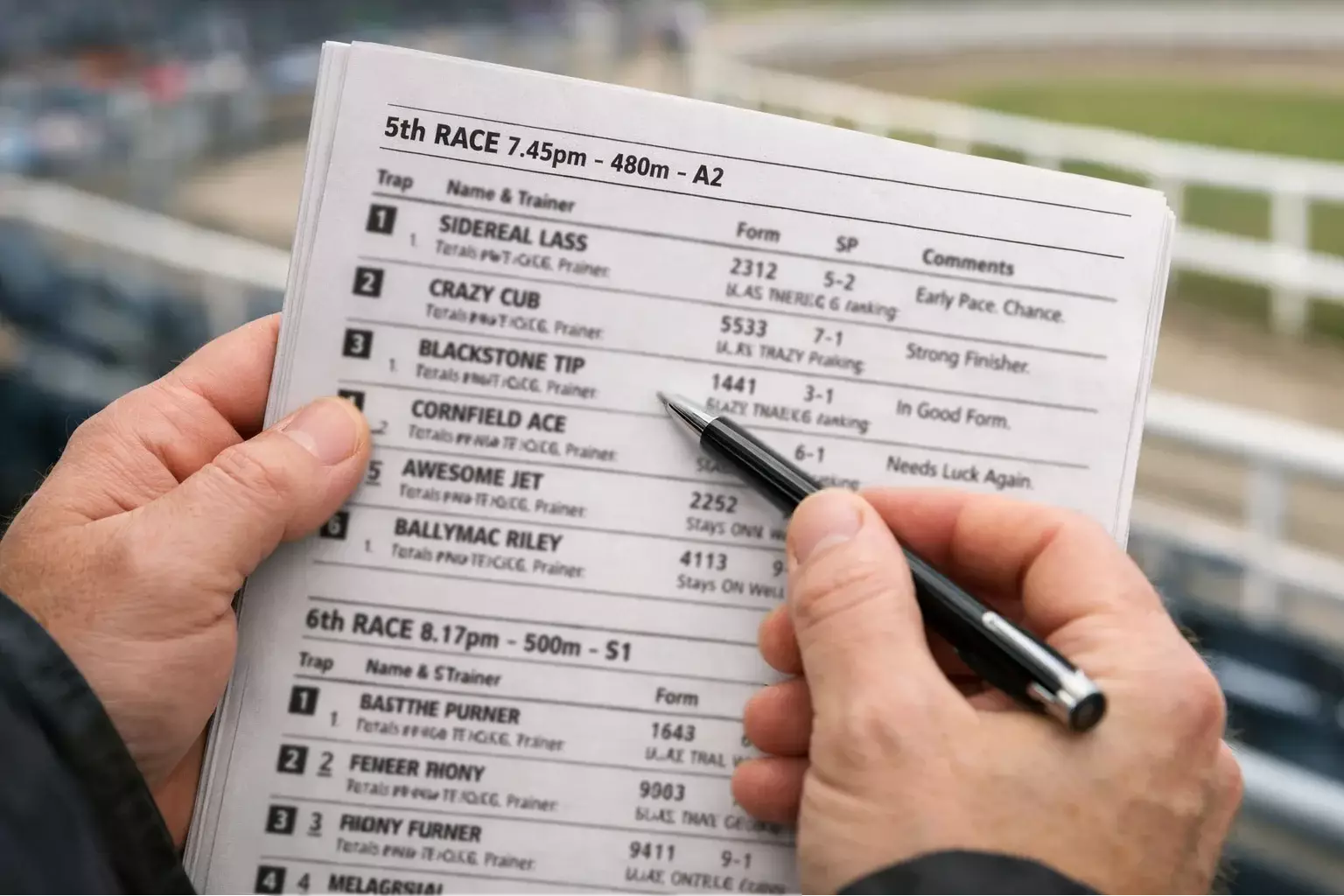
Every greyhound on a UK racecard carries a form string: a sequence of numbers and letters that encapsulates recent racing history in compact code. Reading this string correctly opens the door to understanding what a dog has actually been doing on the track. Numbers tell stories, if you know how to listen.
The standard display shows six runs, most recent on the right. A string like 111234 indicates three wins followed by three progressively worse finishes, reading from oldest to newest. That pattern tells a different story than 432111, which shows a dog coming into form. Before placing any bet, decoding these figures represents the essential first step.
Decoding the String
Each position in the form string represents a race, with numbers indicating finishing position. A 1 means the dog won. A 2 means second place. The scale continues through 3, 4, 5, and 6 for dogs that filled those positions in a standard six-runner field. The most recent race appears on the right-hand side, so the form reads chronologically from left to right.
Letters interrupt the numerical sequence to signal specific circumstances. The most common include F for fell or failed to finish, S for slow away, W for wide running, and T for trial rather than competitive race. These letters provide crucial context that bare numbers cannot convey.
Standard Six-Run Display
UK racecards typically show the last six runs, providing enough history to spot trends without overwhelming detail. This standard format appears across GBGB-licensed tracks and most form publications. Six runs might span several weeks or several months depending on how frequently the dog has raced.
Reading from left to right: a form string 243121 shows a dog that finished second, then fourth, then third, then first, then second, then first in its most recent outing. That pattern reveals a competitive dog with recent improvement, winning two of its last three races after a middling period.
Common Letter Codes
Beyond the basic numerical positions, letters encode important information. F indicates the dog fell or was brought down during the race, meaning the finishing position tells nothing about actual ability. S signals a slow start, which might explain a poor position that followed. W notes wide running, suggesting the dog raced inefficiently by covering extra ground.
T marks a trial run rather than a competitive race. Trials serve various purposes: grading assessments, recovery tests, or practice over unfamiliar distances. Trial times can provide useful information, but the absence of competition changes how the run should be interpreted.
Gaps in the form string, sometimes shown as dashes or blank spaces, indicate periods without racing. These absences might reflect injury recovery, seasonal breaks, or transfers between tracks during which the dog did not compete.
Trap Numbers
Many racecards display trap numbers alongside finishing positions. A form line might read 1³ 2⁵ 4¹, indicating a win from trap three, second from trap five, and fourth from trap one. This additional detail reveals trap preferences and helps assess whether draw has helped or hindered recent performances.
Dogs that show strong form from outside traps but poor form from inside might struggle with crowding. Conversely, a runner that only wins from trap one or two may depend heavily on securing the rail early. These patterns inform expectations for the current draw.
Pattern Recognition
Form strings reveal trends that individual races cannot show. Improving dogs display progressively better finishing positions. Declining dogs show the opposite trajectory. Consistent performers cluster around the same positions, winning enough to stay competitive without dominating or collapsing.
Improving Form
A string like 654321 represents the ideal improvement curve: steady progress from back-marker to winner across six runs. Such dramatic trajectories are rare, but the principle applies to subtler improvements too. A dog showing 443221 has clearly found something, winning once and placing twice in its last three after struggling earlier.
Improvement often coincides with other factors: distance changes, trainer switches, or recovery from minor issues. The form string signals the improvement; detailed analysis explains why it happened and whether it can continue.
Declining Form
The reverse pattern carries warning signs. A form line 122344 shows a dog that was winning or placing consistently but has recently dropped away. Possible causes include injury, fitness decline, or simply meeting better opposition. Without understanding the reason, backing such a dog carries obvious risk.
Track injury rates in UK licensed racing fell to a record low of 1.07 percent in 2024, but injuries still occur and often manifest through declining form before any official report. A dog that was finishing strongly three starts ago but cannot keep pace now may be carrying a niggle that affects performance without causing visible lameness.
Consistency Patterns
Some dogs settle into consistent patterns that repeat indefinitely. A form string 232323 suggests a dog that places regularly but rarely wins. Such runners can offer value in place markets or each-way betting, where their reliability compensates for limited win potential.
Other patterns indicate tactical rigidity. A dog showing 161516 has been either winning or finishing last, nothing in between. This profile suggests a front-runner that dominates when leading but quits entirely when headed. These dogs require favourable draws and weak early-pace rivals to succeed.
Reading Between the Runs
Gaps between races matter as much as the races themselves. A form string with a long break followed by moderate returns might indicate recovery from injury. The first run back often serves as a fitness test rather than a serious winning attempt. Subsequent improvement suggests the dog is regaining full condition.
Frequent racing without breaks indicates a dog in regular training, likely at peak readiness. Sporadic appearances might signal ongoing issues, trainer uncertainty about the dog’s best distance, or simply an owner’s limited appetite for entry fees.
Form in Context
Form figures mean nothing without context. A string of 111111 looks impressive until you learn those wins came at A8 level against weak opposition. A string of 333333 appears mediocre until you discover those thirds were earned against open-class competition at A1 grade.
Grade context transforms form interpretation. Winning at lower grades indicates a dog good enough to dominate weaker fields but says nothing about ability against better rivals. Placing consistently at higher grades suggests a quality runner that might prove too strong when dropped in class.
Track and Distance Context
Form earned at different tracks requires adjustment. A dog that has been racing at Nottingham shows form that may not transfer directly to Romford’s tighter circuit. With only 18 licensed tracks remaining in the UK as of January 2025, dogs frequently move between venues, making cross-track form analysis essential. The finishing positions remain valid, but the competitive context differs. Always check where form was earned, not just what the numbers say.
Distance matters equally. A dog with good form over 400 metres might struggle at 575 metres, or vice versa. If recent runs came over distances different from today’s race, the form carries less predictive weight. Specialist sprinters and stayers rarely translate their form across distance categories.
Running Style Implications
Form figures hint at running style when read carefully. A dog that consistently finishes first or second but never worse likely leads throughout: it either wins when clear or places when just caught. A runner showing mixed positions including late wins probably comes from behind, capable of overhauling tiring leaders.
These style indicators inform trap draw analysis. Front-runners need clear running room; closers need something to chase. The same form string from two different running styles suggests different betting approaches depending on the race shape.
Check GBGB racing information for official rules on how form is recorded and displayed across licensed tracks.
Important Information
Form figures represent historical performance and cannot guarantee future results. Multiple variables affect greyhound racing outcomes beyond recent form. Betting carries financial risk, and you should only wager amounts you can afford to lose. Support services including GamCare and BeGambleAware offer help if gambling causes difficulty.
This guide provides educational information only and does not constitute betting advice. No affiliation exists between this publication and the GBGB, any licensed track, or any betting operator.
Greyhound Form Figures Explained — More on this topic at results romford dogs.
See also Romford Trainer Statistics.
