 Romford Dogs
  Available in US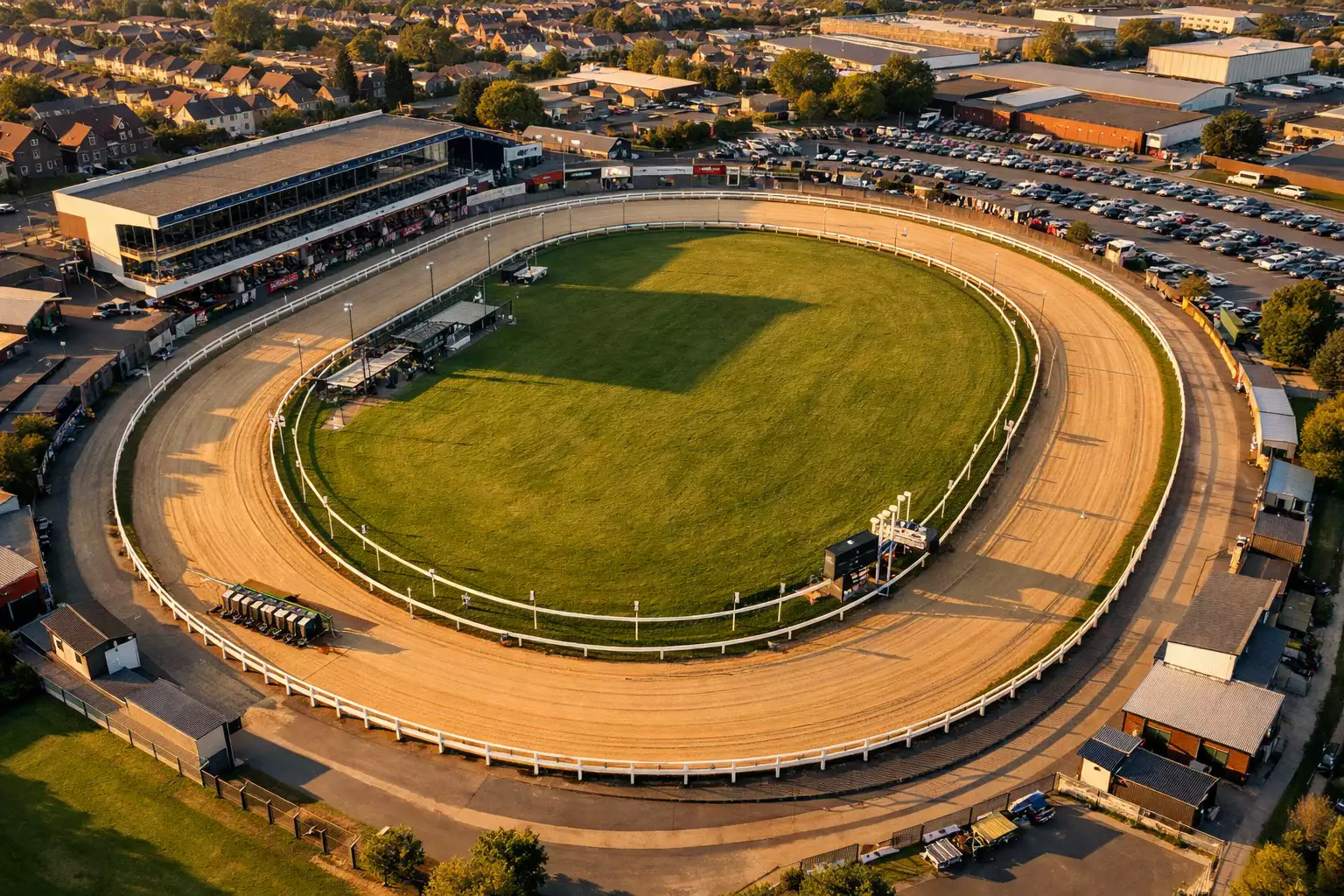
Romford stands as London’s last greyhound track, the sole survivor of a circuit that once scattered stadiums across the capital. Understanding how Romford compares to other UK venues helps place its characteristics in context. Every track has quirks: different circumferences, varying surfaces, distinct trap biases. Dogs that thrive at one venue may struggle at another, and form earned elsewhere does not always transfer cleanly.
With only 18 licensed tracks remaining across the UK as of January 2025, the network has contracted dramatically from its mid-century peak. Each surviving venue occupies a niche, and Romford’s position as the last standing in Britain’s largest city gives it particular significance. For punters, visitors, and form students alike, knowing how this track measures against the alternatives sharpens analysis and expectation.
UK Track Landscape
The shrinking circuit tells its own story. In the 1940s, over 77 licensed tracks operated alongside more than 200 independent flapping tracks. Crowds packed stadiums across industrial cities and suburbs alike. Greyhound racing rivalled football as a spectator sport, drawing millions through the turnstiles each year.
Today’s 18 licensed venues represent the survivors of decades of closures. Economic pressure, property development opportunities, and shifting leisure habits have steadily reduced the network. The closure of Crayford in January 2025 removed London’s second-to-last track, leaving Romford alone in Greater London.
Regional Distribution
Current tracks cluster in certain regions while leaving others unserved. The Midlands retain several venues including Nottingham, Monmore Green, and Perry Barr. The North has Newcastle and Belle Vue among others. Scotland maintains a presence at Kinsley. The South outside London now relies primarily on tracks in the Home Counties and along the coast.
This geography affects how dogs move between venues and which tracks compete for similar catchment areas. Trainers in the Southeast increasingly depend on Romford as their local option, concentrating quality in the Essex venue. Dogs that might have split time between Romford and Crayford now race exclusively at Romford or travel further afield.
Track Categories
Not all tracks serve identical purposes. Some focus on BAGS racing, producing content for betting shops throughout the day. Others maintain stronger evening programmes with higher prize money and feature competitions. A few host category-one events, the sport’s most prestigious races that attract nationwide entries.
Romford balances both roles. Its six meetings per week include daytime BAGS fixtures alongside flagship Friday and Saturday evening cards. This mix keeps the venue active throughout the week while preserving slots for higher-profile racing. The track’s metropolitan location and transport links support both casual visitors and serious racing audiences.
Refer to the GBGB Racing for the current list of operating tracks and their locations.
Romford Specifications
Romford operates on a 350-metre circumference track, placing it in the mid-range among UK venues. Neither the tightest nor the most spacious, this configuration affects running styles and trap biases in predictable ways. Dogs that handle bends well prosper here; pure galloping types may prefer larger circuits with gentler curves.
The track offers five racing distances: 225, 400, 575, 750, and 925 metres. This range spans from pure sprint to genuine marathon, allowing specialists across the distance spectrum to find suitable races. The 400-metre trip serves as the standard, accounting for the majority of races on any given card.
Surface and Maintenance
Like most UK tracks, Romford races on sand. Surface composition and maintenance standards affect going conditions, which in turn influence running times and dog performance. The track undergoes regular maintenance including harrowing, grading, and periodic full renovations to maintain consistency.
Weather impacts the racing surface significantly. Rain softens sand, slowing times and changing the physics of cornering. Prolonged dry spells can produce firmer going that favours certain running styles. Observant punters note going descriptions and adjust expectations accordingly.
Trap Configuration
Six-dog fields represent the standard across UK racing, and Romford is no exception. The trap layout positions runners one through six from inside rail to outside. Inside traps enjoy shorter runs to the first bend on standard distances, creating a measurable bias that varies by distance and draw.
The 225-metre sprint starts near a bend, amplifying inside trap advantages. Longer distances with straight starts reduce but do not eliminate this bias. Understanding how trap position interacts with Romford’s specific dimensions informs draw analysis for every race on the card.
Racing Quality
As the sole Greater London venue, Romford attracts a strong population of resident trainers and regular entries from the Home Counties. The concentration of metropolitan kennels produces competitive fields across most grades. Dogs graded A3 at Romford typically face stiffer opposition than equivalently graded runners at smaller provincial tracks.
Prize money reflects the track’s status. Evening cards offer purses that rank competitively among UK venues, drawing quality entries. BAGS meetings provide additional racing opportunities, though with lower stakes. The combination sustains a healthy racing programme with depth across the grading spectrum.
Comparison with Other Venues
Track circumference varies considerably across UK venues. Towcester’s 420-metre circuit ranks among the largest, producing more galloping racing with gentler bends. Crayford, before its closure, ran on a tight 340-metre track similar to Romford. Perry Barr in Birmingham and Sheffield both operate mid-sized circuits.
How Circumference Affects Racing
Tighter tracks favour different types of dogs than spacious circuits. On smaller circumferences like Romford, bend speed and agility matter more. Dogs must negotiate tighter corners more frequently, placing premium on balance and cornering ability. Front-runners find it easier to hold position because overtaking opportunities come less readily.
Larger tracks reward sustained galloping and strong finishing. More straight running means fewer corners to navigate. Late closers have more ground to make up lost distance. The racing tends to be more open, with positional changes occurring throughout rather than settling early.
Distance Offerings
Most tracks offer standard distances clustering around 450 to 500 metres, though exact measurements vary. Sprint distances range from around 210 to 280 metres depending on track configuration. Marathon trips can extend beyond 900 metres at venues with suitable layouts.
Romford’s distance range of 225 to 925 metres provides good variety. Some tracks concentrate on a narrower band, specialising in particular distance categories. Dogs moving between venues may find their preferred distance unavailable or configured differently.
Transfer Form Assessment
Dogs transferring from one track to another require careful assessment. Form earned at a vastly different circumference may not transfer directly. A dog that dominated at a large galloping track might struggle on Romford’s tighter bends. Conversely, a skilled cornering specialist from Romford could find more room to express its finishing pace on a larger circuit.
Grading adjustments often accompany transfers. A dog graded A3 at a weaker track may find itself reclassified A4 or A5 upon arriving at a more competitive venue like Romford. Watch for these adjustments when dogs appear for the first time at unfamiliar tracks.
Time comparisons require caution. A 24.00-second 400-metre time at one track does not equal the same time elsewhere. Surface, configuration, and measurement variations all affect clocked times. Compare dogs against track standards rather than raw times from different venues.
Important Information
Track specifications and operational details can change. Always verify current information before travelling or placing bets. Betting on greyhound racing carries financial risk, and stakes should remain within what you can afford to lose. Organisations like GamCare and BeGambleAware provide support if gambling becomes problematic.
This comparison guide is provided for informational purposes only. No affiliation exists with the GBGB, Romford Stadium, or any other greyhound venue or betting operator.
Romford vs Other UK Tracks — More on this topic at results romford dogs.
See also GBGB Injury Recovery Scheme.
